Cash movement recorded in real time
Track buy-ins, cash-outs, fills, credits, drops, reversals, and table context without reconstructing the shift from memory.
Record the Event
Capture cash at the point of activity.
Cash accountability starts when the money moves, not when someone remembers to log it. Buy-ins, cash-outs, and threshold context — captured live, attributed immediately.
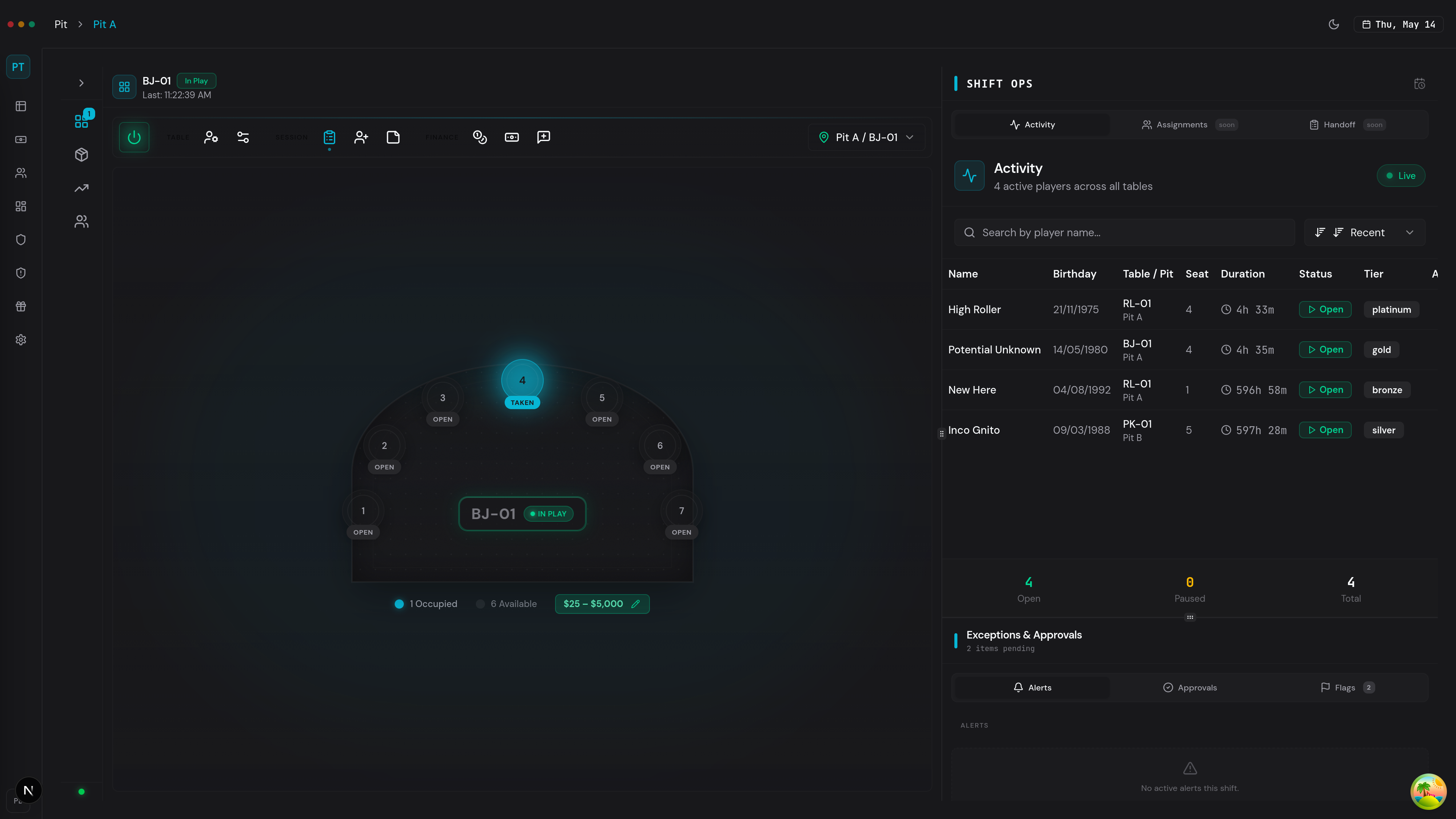
PIT TERMINAL
Floor Operations → Session Tracking → Cash Accountability
Active tables, open sessions, and cash entry in one surface. Buy-ins and cash-outs recorded at the point of activity with live threshold proximity feedback.
Buy-in recording
Record the buy-in at the table as it happens. Staff identity, amount, denomination, and table context captured at the point of entry.
Cash-out recording
Process cash-outs with the same attribution and context. Large-amount confirmation gates catch high-value events before they post.
Live threshold feedback
As the number is entered, the system shows proximity to compliance thresholds. Progressive alerts at $3K, CTR banner at $10K.
Staff attribution
Every cash event carries the identity of the person who recorded it. No shared logins, no unsigned entries.
Exceptions
Mistakes stay part of the record.
Reversals and corrections create new records with full lineage. The original entry is preserved. The reason is required. The audit note is permanent.
This is not a system that hides errors. It absorbs them into the controlled record so the shift can be reviewed without guesswork about what happened and why.
Void the transaction
Reverse a cash-out that should not have posted. The original entry is preserved — the void creates a new linked record.
Capture the reason
Every void requires a reason. This is not optional. The system will not process a reversal without one.
Attach an audit note
Add context that explains the situation. The note becomes part of the permanent record alongside the void.
Confirmations
Cash moves between roles. The trail follows.
Fills, credits, and drops pass through handoff points. Each confirmation step is recorded — who sent, who received, and whether the amounts matched.
Fill confirmations
Chips move to a table. The cashier confirms the fill. Discrepancy notes capture any variance between request and delivery.
Credit confirmations
Chips return from a table. Same confirmation flow, same discrepancy handling, same attribution.
Drop acknowledgements
Drop box contents are acknowledged by the receiving party. The chain of custody is recorded, not assumed.
Table Context
Every dollar traces back to a table.
Cash events do not float loose. They accumulate at the table level — inventory, drops, fills, bank summary, and rundown. The shift review is grounded in where the money was.
Chip inventory
Inventory by denomination at the table level. Know what is on the table right now, not what was there at shift start.
Drop and fill tracking
Every drop, every fill, every credit — accumulated at the table and visible in the table context.
Bank summary
Opening inventory, current state, and net movement. The table-level financial picture during and after the shift.
Rundown report
End-of-shift table accounting. Chip count, drop total, fill total, and computed hold — structured for review.
Attribution
The record holds up because authorship was preserved.
Every entry, confirmation, reversal, and note carries the identity of who recorded it. When the shift is reviewed, you can see who did what, not just what happened.
Who entered
The staff member who recorded the original event.
Who confirmed
The staff member who acknowledged the movement on the receiving end.
What changed
Reversals, voids, and corrections — each linked to the original with full context.
What was noted
Discrepancy notes, audit notes, and reason captures — permanently attached.
Continue exploring.
Cash accountability is one operating loop. The system supports three more.